
Impulsa Mendoza CEO Sebastián Piña joined Minister of Energy and Environment Jimena Latorre and Director of Mining Jerónimo Shantal for three days of meetings and activities in Chile aimed at strengthening regional integration and creating new opportunities for the development of Mendoza’s mining industry.
The agenda began with the SONAMI Mining Summit 2026, organized by Chile’s National Mining Society (SONAMI), continued with the First Ministerial Meeting on Strategic Minerals for Regional Integration, and included additional activities bringing together government officials, business leaders, and industry experts.
“During these meetings, we identified several areas where we share common ground regarding the work ahead, particularly when it comes to regional integration,” said Jimena Latorre, Mendoza’s Minister of Energy and Environment.
Latorre noted that this cooperation extends beyond mining development itself and encompasses other essential components needed for projects to move forward and generate value chains on both sides of the Andes.
“That is the major challenge, particularly for the Andean region and for both the mining and energy industries. Infrastructure, capital, and the development of the human talent needed to work in these industries are issues that concern us and that both countries are actively addressing,” she said.
The Mining Summit, led by President of Chile José Antonio Kast, also brought together ministers from across the Americas and the Caribbean, governors from northern Chile, national and international experts, public-sector representatives, and stakeholders from large-, medium-, and small-scale mining operations.
SONAMI Mining Summit 2026
In its first edition, the SONAMI Mining Summit 2026 brought together more than 1,300 participants, including government officials, experts, and hundreds of representatives from small-, medium-, and large-scale mining companies.
The event provided a forum for strategic dialogue aimed at building consensus to reinvigorate investment, address regulatory challenges, and strengthen the mining industry’s leadership across the region.
Following the opening session, a plenary panel brought together mining ministers and senior officials from Canada, Argentina, Bolivia, Ecuador, and the Dominican Republic to discuss a common agenda that could enable Latin America and the Caribbean to lead the next cycle of global mining growth.
Regional Integration as a Key Priority
One of the central events on the agenda was the First Ministerial Meeting on Strategic Minerals for Regional Integration, held in Santiago, Chile.
The meeting brought together mining authorities from Argentina, Bolivia, Peru, and Chile to advance a shared vision of the region’s strategic role in the responsible supply of critical minerals required worldwide for the energy transition, digitalization, and technological development.
During the meeting, authorities from the four countries also formalized a strategic alliance to deepen cooperation on critical minerals and position the Southern Cone as a reliable, sustainable, and competitive supplier amid growing global demand.
The agreement was signed by the highest-ranking mining authorities from each country: Daniel Mas, Chile’s Minister of Economy and Mining; Luis Lucero, Argentina’s Secretary of Mining; Walter Landívar, Bolivia’s Vice Minister of Mining Policy, Regulation and Oversight; and Guillermo Shinno, Peru’s Minister of Energy and Mines.
The initiative seeks to strengthen the responsible extraction of resources such as copper and lithium, considered essential for electric mobility, artificial intelligence, and energy decarbonization. At the same time, it aims to reinforce supply chains and promote greater value-added production within the region.
“Mining Outlook in the Region” at the Argentine Embassy
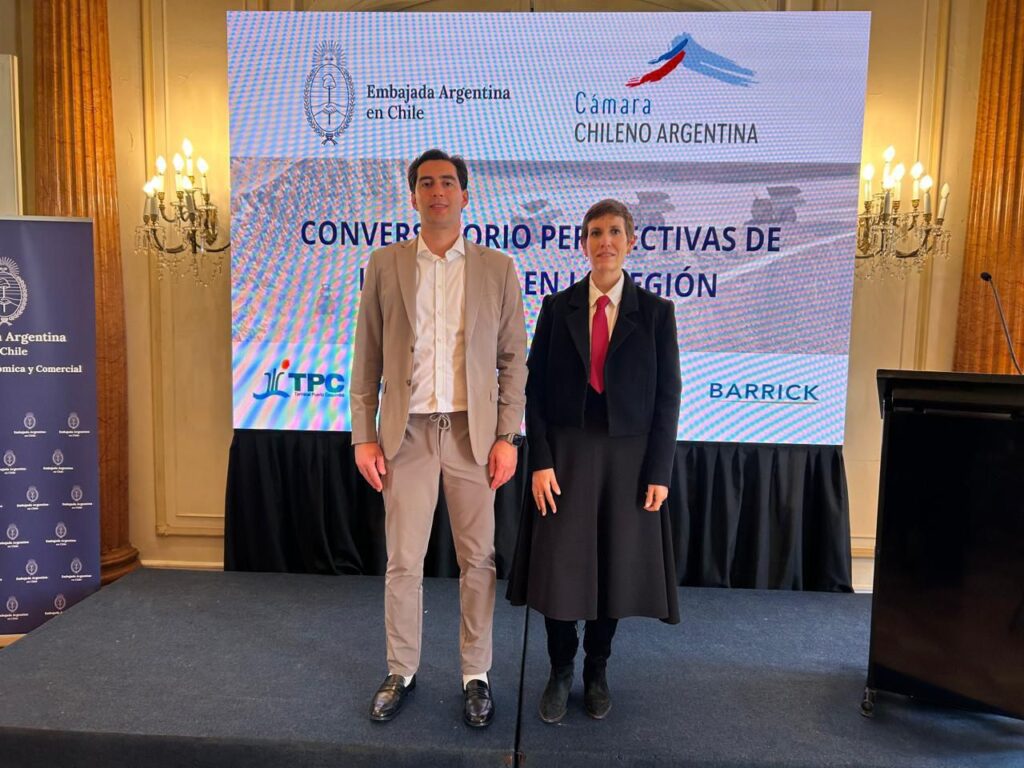
At a meeting that brought together public- and private-sector representatives, Argentine Ambassador to Chile Jorge Faurie led the “Mining Outlook in the Region” series.
The agenda included a panel focused on the current status and short-, medium-, and long-term outlook for some of the region’s major copper projects.
Michael Meding, General Manager of Los Azules, presented the project’s progress and outlook; Iván Grgic, Glencore’s Public Affairs Manager, discussed El Pachón; and representatives from Vicuña addressed the current status and future prospects of that development.
Another session focused on the execution of large-scale mining projects, successful experiences, and the challenges involved in advancing greater integration in cross-border mining.
The event also featured a dedicated discussion on the outlook for mining development in Argentina and Chile. Chile was represented by Undersecretary of Mining Álvaro González, while Argentina’s presentation was delivered by National Secretary of Mining Luis Lucero.
The institutional closing remarks were delivered by Charles Kimber, President of the Chilean-Argentine Chamber of Commerce.
Mendoza Suppliers and New Operators
The regional agenda also highlighted the need to ensure that integration extends beyond major mining projects to include suppliers and the broader productive ecosystem associated with the industry.
This strategy seeks to expand opportunities for Mendoza-based companies providing services, technology, engineering, logistics, and other capabilities that can become part of the mining value chain. At the same time, it aims to bring expertise, technical capabilities, and operators from countries with established mining industries closer to Mendoza.
Strengthening regional partnerships could help build a mining industry with greater scale while creating new opportunities for local suppliers to participate in broader regional and international value chains.