What are metallogenic belts and how many have been identified in Argentina?
Metallogenics is the study of the genesis (origin) of mineral deposits in the Earth’s crust, defining their location in time and space within the geological context.
Geological events that occurred in specific eras and areas of the Earth’s crust conditioned the formation of mineral deposits. By studying and associating environments with each type of mineral deposit, we can infer what types of deposits may exist based on geological characteristics.
With this geological history, it is possible to create “favorability maps” that reveal the areas with the highest probability of finding minerals. Knowing the spatial and temporal distribution and geological characteristics of known mineral deposits has allowed for the definition of potential deposit models linked to a specific geotectonic environment.
Based on this, prospectable areas with the potential to discover the defined types of deposits can be delineated. These common characteristics that group mineral deposits are called metallogenic provinces, which can be further subdivided into metallogenic belts.
According to the Argentine Geological and Mining Service (SEGEMAR), nine metallogenic belts favorable for mineral exploration and exploitation are recognized in Argentina. These belts are associated with the country’s geological activity and the presence of various types of mineral deposits. The main belts are:
Andean Metallogenic Belt: Extending along the Andes Mountains, this belt is rich in metals such as copper, gold, silver, molybdenum, and zinc. It is associated with large porphyry and epithermal deposits.
Epithermal and Subepithermal Gold Metallogenic Belt: It is found mainly in northwestern Argentina and is associated with the formation of gold and silver in epithermal and mesothermal deposits.
Metallogenic Belt of the Porphyry Copper Belt: Located in the west of the country, along the Andes Mountains. It is one of the main copper-producing belts, associated with porphyry copper deposits.
Uranium Metallogenic Belt: Located in the south-central region of the country, this belt is key to uranium mining, particularly in the provinces of Mendoza, La Rioja, Chubut and San Juan.
Metallogenic Belt of the Sierra Pampeana: It extends through the northwest and center of the country, and contains metals such as lead, zinc, silver and tin, in hydrothermal and vein deposits.
Patagonian Metallogenic Belt: Located in Patagonia, with deposits of gold, silver, copper, and industrial minerals. It is found in the provinces of Chubut and Santa Cruz, and is associated with low-sulfidation epithermal deposits.
Somuncurá Plateau Metallogenic Belt: Located in Patagonia, it is linked to deposits of industrial minerals such as gypsum, bentonite, and barite.
Metallogenic Belt of the Sub-Andean Ranges: In northwestern Argentina, with deposits of zinc, lead, silver and manganese in stratabound deposits.
The Precordillera and Cuyo Metallogenic Belt: Covering parts of Mendoza and San Juan provinces, this belt is associated with copper, silver, gold, and lead deposits. It is linked to stratabound deposits of hydrothermal origin.
These belts represent the most promising areas for metal exploration in Argentina and are linked to the country’s complex geological history.
How many of these belts are located in Mendoza?
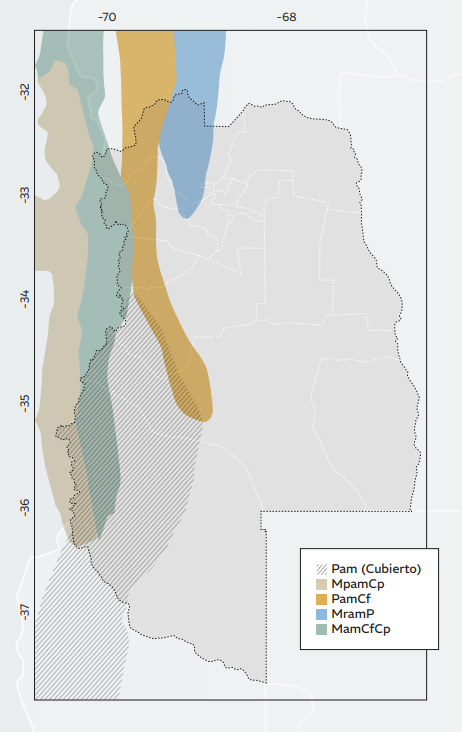
Mendoza is crossed by five of the main metallogenic belts. Studies by the Argentine Geological Survey confirm that the province possesses materials in its soil and subsoil that are critical for the energy transition, such as copper, cobalt, and uranium; essential for industry, such as iron; for technology, such as gold and silver; and for food security, such as potassium.
The most promising belts—in terms of copper potential—extend from Chile and continue into Mendoza, entering the southern part of the province in the Malargüe department.
These include the giant deposits of El Teniente and the Río Blanco-Los Bronces cluster, located immediately west of the Mendoza mountain range and near the international border.
There are also other areas with high geological potential for exploration in the rest of the province, related to copper porphyries, epithermal and polymetallic deposits, sedimentary deposits of copper, uranium, and vanadium, and also evaporite deposits (potassium).
The existing and untapped mining potential in the province of Mendoza is used to estimate its economic potential, the value of which can be approximated by referencing the levels of mining activity and production value in Chile and San Juan, with which we share the Andes Mountains.