
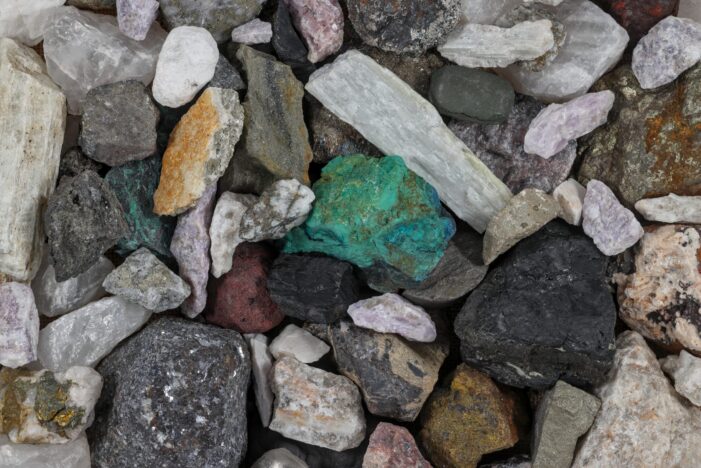
What are minerals and how are they formed?
Minerals are the essential elements that make up rocks and are present everywhere: from the ground we walk on to the objects we use every day.
To explain how they are formed, it is essential to understand what a mineral is. A mineral is a naturally occurring, inorganic substance with a defined chemical composition and an ordered crystalline structure.
They are solids that form through geological and chemical processes, which excludes substances produced by living organisms, such as plants or animals. Minerals occur in various shapes and sizes, and their properties depend on both their chemical composition and their crystalline structure.
Minerals are fundamental to numerous industries and are used in the manufacture of a wide variety of products, from solar panels and cell phones to electronic components. The large quantity and diversity of minerals present in the Earth’s crust makes them an essential resource for the development of life as we know it.

There are several mineral formation processes…
1- Magmatic mineral formations
The origin of many minerals lies in molten rock (magma) found inside the Earth at temperatures between 650 and 1250°C. These liquid masses can sometimes rise to the surface, cooling as they ascend. During the initial stages of this cooling, minerals such as apatite and magnetite form. Later, as the temperature decreases further, most of the magma solidifies, giving rise to minerals like feldspars and quartz.
After this phase, a small amount of residual magma remains, enriched with elements (such as boron, molybdenum, uranium, and rare earth elements) that were unable to form minerals. The crystallization of this residual magma gives rise to other minerals.
2- Sedimentary mineral formations
Water transports dissolved materials, eroded from rocks, such as salts or carbonates, and deposits them in specific locations. When this water evaporates, it causes the dissolved materials to precipitate, crystallizing to form evaporite rocks.
3- Formations of metamorphic minerals
The last category consists of minerals that, although initially magmatic or sedimentary, undergo changes when exposed to high temperatures or pressures. This gives rise to a process called metamorphism, where the mineral’s crystalline structure changes.