How are minerals classified?
Minerals are classified according to their chemical composition and crystalline structure, based on the predominant anion or anionic group. The most common classification includes several groups:
- Silicates: These contain silicon and oxygen and are the most abundant minerals in the Earth’s crust. Examples include quartz and feldspar.
- Carbonates: Formed by calcium carbonate and other metals, such as calcite and dolomite.
- Oxides: Compounds of oxygen and other elements, such as aluminum oxide (bauxite) and iron oxide (hematite).
- Sulfides: They contain sulfur and metals, such as pyrite and galena.
- Phosphates: Formed from metal phosphate, such as apatite.
- Halides: Minerals that contain halogens, such as rock salt (halite).
The factors that influence its formation:
· Geological conditions: Temperature, pressure, and the geological environment are fundamental. For example, minerals can form from magma or hydrothermal solutions.
· Time: The duration of geological processes can affect the type and amount of minerals that form.
· Chemical composition: The availability of certain elements in the environment determines which minerals can form.
· Biological activity: Some minerals, such as phosphates, can be formed through biological processes, although most are inorganic.
These factors interact in various ways, resulting in the variety of minerals found in nature.
What role do geological cycles, such as the water and rock cycles, play?
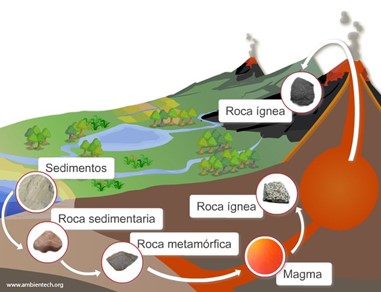
The rock cycle is the fundamental process by which igneous, sedimentary, and metamorphic rocks are transformed from one form to another in a constant cycle driven by the Earth’s geological processes.
1. Internal processes
Igneous or magmatic rocks
The rock cycle begins when volcanoes expel magma to the Earth’s surface. This magma contains a variety of molten minerals which, upon cooling, form crystalline structures and together create igneous rocks.
Igneous rocks can also form beneath the Earth’s surface when magma is unable to reach the surface. In this case, the magma cools slowly, solidifies into rock, and, along with the movement of the Earth’s crust, rises to the surface.
Therefore, igneous rocks can form in two ways: on the surface or within the Earth’s crust. Then, depending on their location and the effects of erosion from water and wind, these igneous rocks are worn down and fragmented, eventually forming fine rock sediments. These sediments include volcanic and plutonic rocks.
Metamorphic rocks
Metamorphic rocks are formed from the transformation of other rocks. When these rocks are trapped between layers of earth, their structures change due to high pressure and high temperatures.
2. External or exogenous processes
Sedimentary rocks
Sedimentary rocks are formed by the accumulation of rock sediments. These sediments remain on the Earth’s surface and are affected by erosion and movement. Once deposited, they form different types of rocks. Among the sedimentary rocks are dendritic rocks, chemical rocks, and organic rocks.
In the following image, you can see a summary of the rock cycle: