
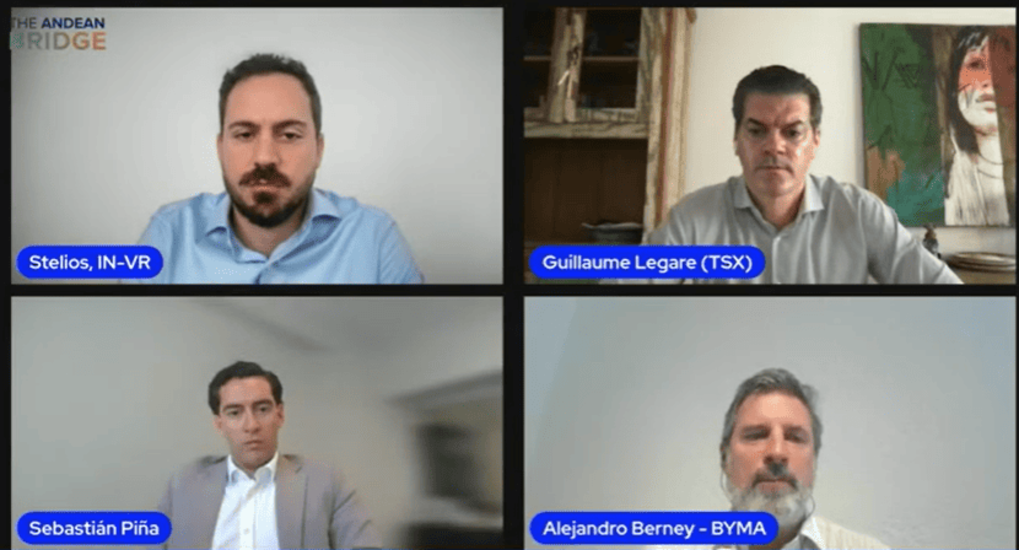
As part of Mendoza’s strategy for regional financial integration and international positioning, Impulsa Mendoza participated in the webinar “Mobilising Capital for the Andes: Inside the Andean Bridge,” a discussion forum that brought together leaders from capital markets, international stock exchanges, and investment promotion organizations linked to project development in the Andean region.
The webinar focused on building a financial bridge capable of connecting global capital more efficiently with strategic projects across the Andes, strengthening coordination among markets, issuers, and investors.
In addition to Impulsa Mendoza CEO Sebastián Piña, the webinar featured Stelios Papagrigoriou, Founder and Executive Chairman of IN-VR and CEO of Theros Capital; Guillaume Légaré, representative of the Toronto Stock Exchange and TSX Venture Exchange; and Alejandro Berney, Director at BYMA – Bolsas y Mercados Argentinos.
Sebastián Piña: Efficiency, Capital and Accelerating Exploration
Piña explained that Mendoza seeks to position itself as a financial center capable of connecting global capital with projects throughout the Andean region. He noted that a sustainable mining industry requires strong exploration activity, and that exploration depends directly on access to capital markets.
In this regard, he stressed that mining development cannot be viewed solely from the perspective of geological resources, but also from the ability to structure competitive financing and attract international investment.
“We understand our comparative advantage, which can help the entire region connect capital and projects in a more efficient way and accelerate exploration,” Piña stated.
He also highlighted Mendoza’s competitive advantages, including highly qualified human resources, consolidated tourism infrastructure, strong air and logistics connectivity, and the presence of universities, banks, and financial brokers.
Piña emphasized that Mendoza has highly skilled human capital and an institutional ecosystem that facilitates interaction between the mining sector and financial markets.
Financial Education and Risk Management
Piña stressed the importance of educating project owners on how to access financing, using models such as the TSX Venture Exchange as a reference.
He also pointed out that Argentina has developed a strong risk management culture as a result of operating within complex economic environments, and that this characteristic can become a competitive advantage for high-risk investments such as mining and exploration.
Finally, he stated that the success of the Andean Bridge initiative will depend on the private sector’s commitment to continue driving it forward and consolidating it as a platform that creates value, connects stakeholders, and generates concrete investment opportunities.
Stelios Papagrigoriou: Closing the Financial Gap
Stelios Papagrigoriou explained the conceptual origins of Andean Bridge as a response to a structural gap between opportunities and financing.
“Andean Bridge was created precisely to address this gap. Today’s discussion brings together the institutions helping to design that bridge in order to explore how the Andes can evolve from a collection of isolated opportunities into a connected financial ecosystem.”
His remarks focused on the need to transform individual opportunities into an integrated system capable of providing scale, predictability, and confidence for international investors.
Guillaume Légaré: Integrating Global and Local Capital
Representing the Canadian market, Guillaume Légaré emphasized the importance of coordinating stakeholders to expand access to financing.
“There is a very significant base of retail investors in Canada, but also in Argentina. If we work together and connect different stakeholders, I believe that will help issuers access capital — not only global capital through TSX Venture and TSX, but eventually also local equity funds in Argentina and other regional markets.”
His presentation highlighted the potential complementarity between established markets and emerging capital markets.
Alejandro Berney: Growth of Argentina’s Capital Market
Alejandro Berney presented indicators reflecting the recent evolution of Argentina’s capital market.
“We have seen our market grow very significantly. In just the last two years, local issuance volume increased by 90%, surpassing 33 billion — nearly 34 billion — dollars last year. Investor accounts grew from 5 million to 21.6 million over the last two years, which also demonstrates the level of interest from local investors.”
These figures reflect a more dynamic financial ecosystem with greater investor participation, a key condition for strengthening financing for productive projects.
Next Step: The Andean Capital Forum in Mendoza
As a continuation of this regional integration process, Mendoza will host the Andean Capital Forum, an international conference that will take place from April 20 to 22, 2026, with the goal of connecting mining projects from the Andean region with the world’s leading sources of global financing.
The Andean Capital Forum will be held as part of the Andean Bridge initiative and aims to establish a direct channel between mining projects in Argentina, Chile, and Peru and major international financing sources, including institutional investors, capital markets, banks, and specialized funds.
Over three days, the forum will bring together mining companies at different stages of development, investment funds, banks, stock exchanges and capital markets, government authorities, and institutional leaders connected to productive and mining development.
The main objective is to facilitate access to financing, promote high-quality investment, and strengthen regional integration, positioning Mendoza not only for its geological potential, but also as a center for institutional, technical, and financial coordination supporting the sustainable development of Andean mining.