
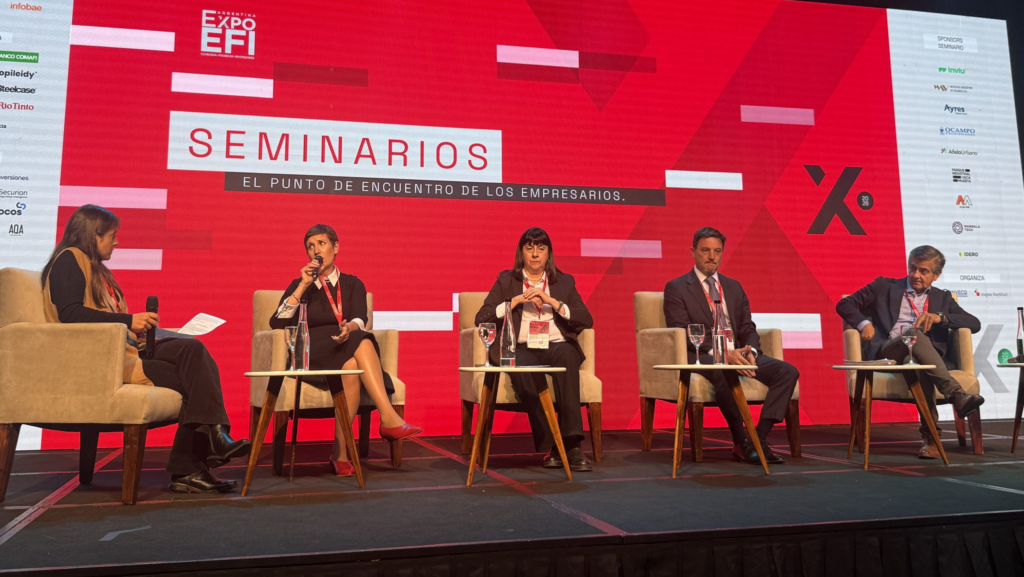
Mendoza Minister of Energy and Environment Jimena Latorre spoke at the seminar “Mining: The Provinces’ Perspective”, held as part of Expo EFI 2026, one of Argentina’s leading forums for discussing the country’s economic outlook, investment climate and international context.
The panel was moderated by La Nación journalist Sofía Diamante and also featured Catamarca Mining Minister Teresita Regalado, San Juan Mining Minister Juan Pablo Perea and Salta Mining Secretary Gustavo Carrizo, who shared their provinces’ perspectives on mining and energy development.
During her presentation, Latorre emphasized that mining and energy development must be approached from a regional perspective, rooted in the shared geological reality of the Andes mountain range. She explained that investment projects already extend across multiple territories as part of the same geological system, making greater coordination increasingly necessary.
“The growth of the energy and mining sectors will go beyond the borders of each province. Today we already see investments spanning different territories, and that responds to a concrete geological reality: the Andes mountain range does not recognize political borders. From Colombia, through Peru, Bolivia and Chile, to Argentina, there is a shared geological potential driving the development of these industries,” Latorre stated.
The minister noted that these processes require time, investment and long-term planning, but are already generating economic activity in local communities. “These are long-term processes, but they are already creating economic movement in the communities where they are taking place, and they pose a challenge: being prepared for what comes next,” she said.
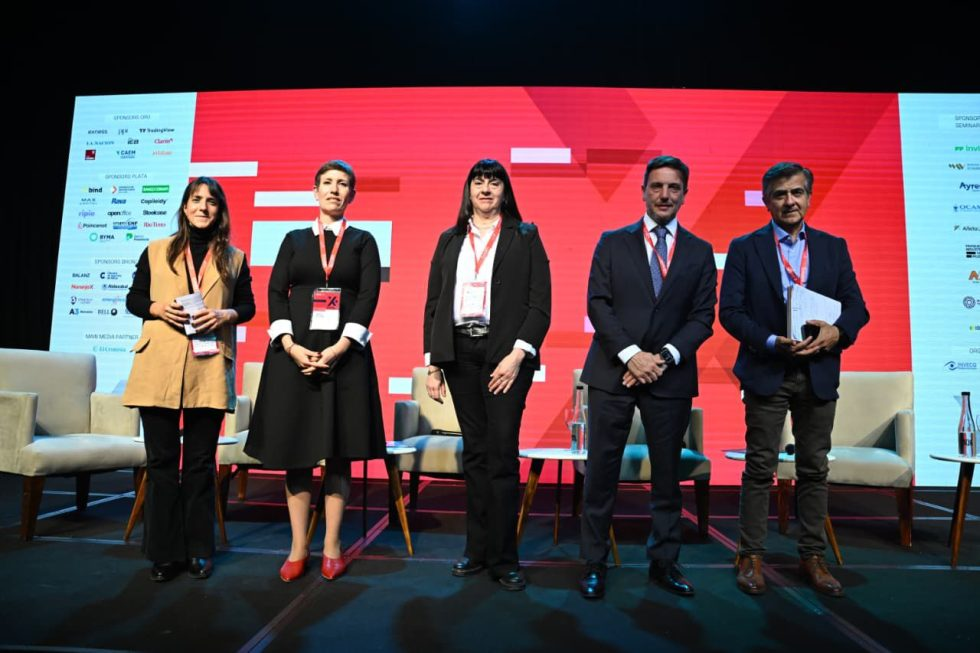
In that context, Latorre detailed Mendoza’s efforts in both mining and energy, focusing on resource development, environmental stewardship, modernization and citizen participation. “We need to start thinking in terms of regionalism, because this integrated vision is what will truly add value to these industries, which clearly go hand in hand,” she added.
Infrastructure, Integration and Productive Scale
One of the central themes of her presentation was infrastructure development as a foundation for expanding productive capacity and supporting sector growth.
“In Mendoza, we are developing road and energy infrastructure using provincial funds under investment-recovery schemes that allow us to continue expanding over time,” Latorre explained.
She also stressed that infrastructure must be part of a broader regional integration strategy. “The challenge is not only to build, but to integrate. We cannot think about railways or connectivity without coordinating regional economies and understanding supplier and export flows,” she said.
Latorre highlighted the importance of logistics, energy connectivity and railway infrastructure, as well as the role of provincial entities in structuring projects capable of accessing financing. “Together with companies such as Emesa and Impulsa Mendoza, we are working to structure projects that can scale and access capital markets,” she noted.
Financing and Conditions for Growth
The minister also pointed to financing as one of the key factors shaping the future of the sector amid growing global demand for strategic resources.
“Today, financing is at the center of the discussion. International capital is available, but we need well-structured projects that are ready to receive investment and move quickly into execution,” she said.
Latorre explained that Mendoza is working with a broader regional perspective through initiatives such as Andean Bridge, designed to connect mining and energy opportunities across the Andean region.
“From the province, we are working to connect financing with projects not only in Mendoza but throughout the Andean region, because that is where the true accelerator for development lies,” she stated.
She also underlined the importance of the State’s role in generating confidence for investors. “A key responsibility of government is to provide certainty and legal security so that Argentina becomes an attractive destination for investment,” she added.
Long-Term Public Policies Across Provinces
During the panel, representatives from the other provinces also shared their perspectives on mining development.
San Juan Mining Minister Juan Pablo Perea emphasized the continuity of mining policy in his province. “In San Juan, mining has been a long-term State policy. We have a consolidated present based on gold production and a future clearly marked by copper, where we concentrate a significant share of the country’s supply,” he said.
Salta Mining Secretary Gustavo Carrizo highlighted the rapid growth of the sector in his province. “In Salta, mining is part of our identity and our public policy. Today we have 45 lithium projects, 25 metallic mining projects and a historic leadership position in borates, which has allowed the mining export complex to become the province’s leading export sector for the first time,” he explained.
Meanwhile, Catamarca Mining Minister Teresita Regalado focused on community relations and environmental oversight. “In Catamarca, we work continuously to strengthen our relationship with society by involving communities in decision-making, monitoring and project evaluation processes. Since the 1990s, we have implemented a system in which the State not only supervises but also replicates the environmental monitoring carried out by companies, especially regarding critical resources such as water,” she said.
Expo EFI: Argentina’s Leading Forum on Economy and Investment
Expo EFI 2026 is being held at the Buenos Aires Convention Center and has become one of Argentina’s main forums for debate on economics, finance and investment. The event features national authorities such as Economy Minister Luis Caputo and Central Bank President Santiago Bausili, along with economists, business leaders, market specialists and private sector representatives.
Organized by Invecq Economic Consulting and Messe Frankfurt Argentina, the exhibition brings together leaders from multiple sectors for two days of conferences, workshops and seminars focused on mining, energy, finance and productive investment.
Mendoza’s participation was particularly significant in positioning the province’s mining and energy agenda within the national debate, bringing forward a vision centered on regional integration, infrastructure development and coordination with capital markets.