
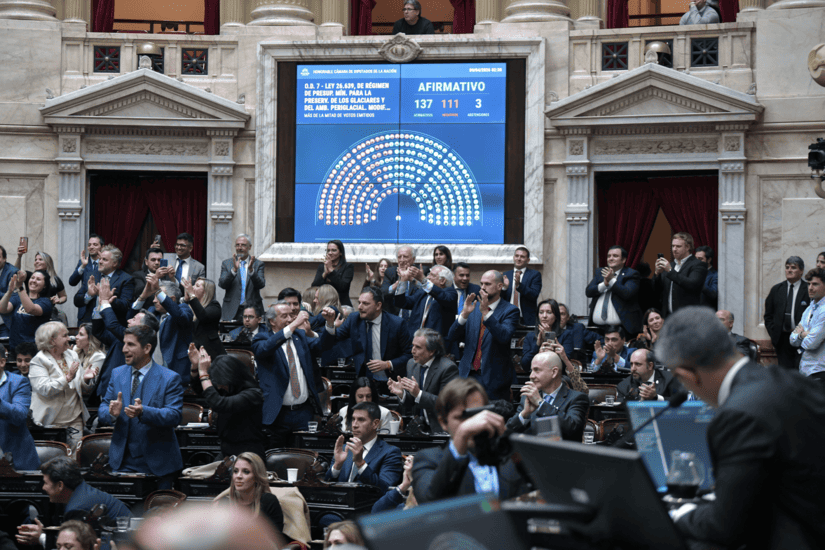
The recent enactment of the new Glacier Law, approved by the National Congress, introduces a significant update to Argentina’s environmental regulatory framework, focused on improving the implementation of existing protections through more precise criteria and stronger institutional coordination. Far from altering the spirit of the original legislation, the update reinforces its application based on scientific evidence and methodological clarity.
Since its approval in 2010, Law No. 26.639 positioned Argentina as a pioneer in glacier and periglacial environment protection, recognizing these ecosystems as strategic freshwater reserves. The new regulation, enacted through Decree 271/2026 following legislative approval, maintains that protection framework while incorporating tools designed to address one of the main technical challenges with greater rigor: the delimitation of periglacial environments.
Periglacial environments: greater technical precision
In this regard, the regulatory update places special emphasis on improving how these areas are identified and characterized. Unlike visible glaciers, periglacial environments may include underground or dynamic formations that require specific field studies, geological analysis and thermal measurements. The incorporation of more detailed technical criteria aims to ensure that decisions are based on robust scientific information, reducing ambiguity and strengthening transparency in environmental evaluation processes.
Stronger coordination between the federal government and provinces
Another central aspect of the reform is the strengthening of coordination between the national government and provincial authorities. In line with Argentina’s Constitution, which recognizes provincial ownership over natural resources, the law reinforces the role of provinces in technical evaluations and decision-making processes, always within the framework of national minimum environmental standards.
This approach promotes greater coordination between different levels of government, integrating information from the National Glacier Inventory with higher-resolution local studies conducted in specific territories.
The regulation also reaffirms key principles such as the precautionary principle, maintaining protection over glaciers and hydrologically relevant geoforms until scientific evaluations demonstrate otherwise. Likewise, the current prohibitions remain in place for activities that could impact these ecosystems, including mining, hydrocarbon development and any intervention capable of significantly altering their natural condition.
Different scales: national baseline and local studies
From an operational standpoint, the update recognizes a fundamental difference in scale. While the National Glacier Inventory serves as a baseline planning tool, decisions regarding specific projects require more detailed information. This distinction does not weaken the protection system; rather, it makes it more precise by enabling evaluations tailored to the specific characteristics of each site.
For provinces such as Mendoza, where water is a strategic resource and mining represents part of the province’s development potential, having a clear and technically sound regulatory framework is essential. The updated law helps reduce uncertainty, improve the quality of environmental assessments and consolidate a model in which water resource protection and productive development can advance in a complementary manner.
Ultimately, this new phase of Argentina’s Glacier Law represents an evolution toward a more precise, transparent and science-based implementation framework — a necessary step to strengthen environmental management while responsibly addressing the challenges of development in high mountain regions.