
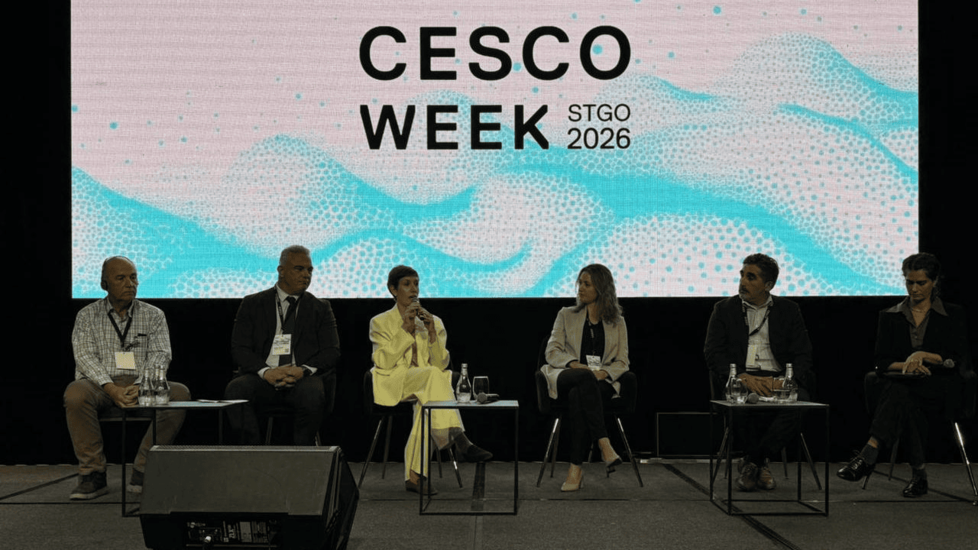
Minister of Energy and Environment Jimena Latorre participated in CESCO Week Santiago, one of the most important international mining gatherings, organized by the Center for Copper and Mining Studies (CESCO), together with Mining Director Jerónimo Shantal and Impulsa Mendoza CEO Sebastián Piña.
The event brought together industry leaders, companies, experts and government authorities to analyze the challenges and opportunities facing the mining sector. Within this framework, the minister took part in the Mining Exploration Forum, a key space for understanding the role of identifying new mineral resources and reserves in project development — a process that not only drives new initiatives but also extends the lifespan of existing operations, ensuring the continuity and sustainability of the sector.
During her presentation on the panel “Mining Districts and New Geological Attractiveness,” the minister outlined Mendoza’s strategy to consolidate new mining districts and strengthen exploration as the foundation for the sector’s growth.
“We explained Mendoza’s vision and the work being carried out to develop new mining districts that encourage mature exploration, allowing mining activity to advance while positioning the productive capacity of Mendoza and Argentina, in synergy with the region, to meet the global copper demand driven by the energy transition and technological development,” Latorre stated.
The panel was moderated by Irene del Real, Director of CESCO and academic at the Pontifical Catholic University of Chile, and also featured international industry leaders including Miguel Tapia, Greenfield Exploration Manager at AMSA; David Hobby, Technical Director at Flagship Minerals (Pantanillo); Andrea Aravena, Vice President of Geology at Hot Chili (Costa Fuego); and Michael Meding, General Manager of Los Azules, McEwen Copper.
The minister emphasized the conditions currently demanded by investors and the role of government in creating a more competitive and predictable environment.
“The risk should be the inherent risk of exploration itself — whether economically viable resources are found or not. However, there are other factors that, as a provincial government, we set out to reduce in order to facilitate investment,” Latorre stressed.
In that regard, she highlighted the reform process promoted by the Province.
“Two years ago, we launched a policy focused on promoting and attracting mining investment, beginning with amendments to the Mining Procedure Code to modernize and streamline processes, addressing key issues such as permitting, mining cadastres, updated mining registries, information systematization and coordination among the different stakeholders within the system,” she said.
CESCO’s Mining Exploration Forum is considered a strategic space for analyzing the status of emerging prospects, evaluating exploration competitiveness and discussing the conditions needed to accelerate new discoveries across Latin America. The integration of regional perspectives helped highlight Mendoza’s geological potential and the importance of advancing cooperation frameworks that position the province as a relevant player in the supply of critical minerals.
In line with this strategy, Mendoza continues to deepen an agenda focused on creating enabling conditions for investment, with an emphasis on regulatory modernization, improved geological information and stronger coordination between the public and private sectors. The province’s participation in CESCO Week Santiago reinforces its positioning as an active territory within the regional mining agenda, with real potential to integrate into global value chains linked to the energy transition.