
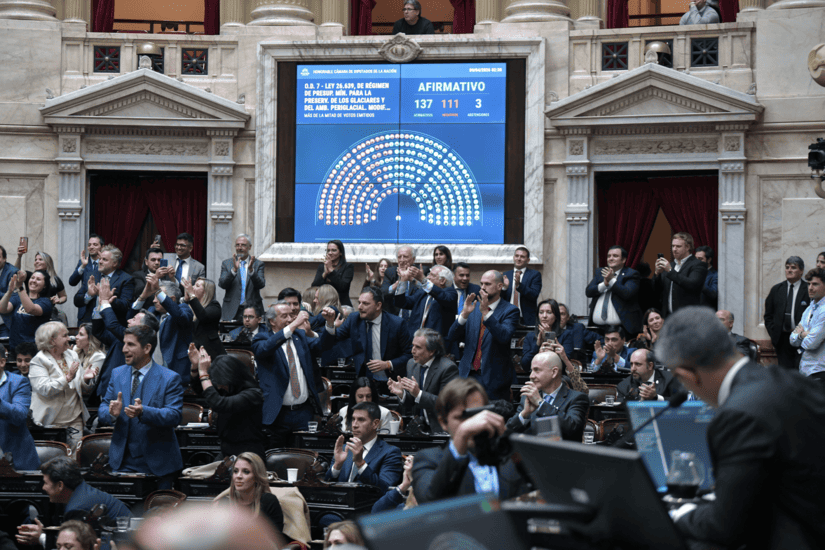
Understanding the legal framework governing strategic natural resources is essential for responsible development. Argentina’s National Law No. 26,639, enacted in 2010 and commonly known as the Glaciers Law, established minimum environmental protection standards for glaciers and periglacial environments, recognizing them as strategic freshwater reserves.
The legislation established a clear principle: protecting ecosystems that play a vital role in water regulation, environmental stability, and the supply of water to communities and productive activities. To achieve this, the law prohibits activities that could alter the natural condition or hydrological function of glaciers and protected periglacial areas.
Argentina was among the first countries to adopt glacier-specific environmental legislation. After more than a decade of implementation, technical and operational challenges highlighted the need to clarify certain methodological criteria without altering the law’s original protective spirit.
What was discussed?
During Argentina’s extraordinary congressional sessions in February 2026, lawmakers debated proposals focused on updating implementation criteria rather than weakening environmental protections. The objective was not to reduce safeguards, but to provide greater clarity regarding how the law should be applied in practice.
The discussions centered on two main issues:
- The definition and delimitation of periglacial environments.
- The distribution of responsibilities between the federal government and provincial authorities.
Both aspects are intended to improve implementation through clearer criteria supported by scientific information and updated methodologies.
The periglacial environment: a technical and methodological challenge
One of the most complex issues involves accurately defining periglacial environments. There is broad consensus regarding the importance of protecting water resources; the debate today is largely technical — specifically, how to precisely map what science considers a protected environment.
From a geomorphological perspective, periglacial environments include areas where freezing and thawing processes influence soil and landscape dynamics. Unlike exposed glaciers, which can be clearly identified through satellite imagery, periglacial areas may contain permafrost or subsurface ice hidden beneath rock and sediment layers.
Their characterization requires field studies, thermal measurements, geological analysis, and hydrological evaluations. These are also dynamic systems, meaning thermal conditions can evolve over time, requiring updated methodologies and technically robust criteria.
Part of the current legislative discussion therefore focuses on improving the methodological tools used to identify and delimit these environments with greater precision.
Scale challenges and the role of the National Glacier Inventory
The National Glacier Inventory (ING), developed by the Argentine Institute of Nivology, Glaciology and Environmental Sciences (IANIGLA) under Article 5 of Law 26,639, serves as a foundational database for characterizing glaciers and related landforms across Argentina. It provided the country’s first systematic and standardized glacier registry at the national level.
However, the Inventory was designed as a large-scale planning tool suitable for regional analysis rather than site-specific evaluations. Producing a nationwide inventory with project-level resolution would be technically, operationally, and economically unfeasible, as it would require extensive field campaigns throughout the Andes.
Recognizing this difference in scale does not undermine the Inventory itself. Instead, it reflects the need for different levels of information depending on the decision-making process. Strengthening coordination between national baseline information and detailed local studies can improve transparency and technical accuracy.
For specific project evaluations, complementary studies with higher spatial resolution are required, including field campaigns, geotechnical analysis, thermal measurements, and detailed terrain assessments.
Under the approved reform, provincial jurisdictions would be responsible for requesting and managing these higher-resolution studies to more accurately determine the extent and characteristics of periglacial environments in each case.
Importantly, this technical deepening does not authorize development in protected areas. The legal prohibition affecting glaciers and periglacial environments remains fully in force. The reform instead seeks to ensure that protected areas are identified through more rigorous scientific criteria and updated information, strengthening transparency and the technical basis of environmental decisions.
Greater provincial participation and technical responsibility
The second major component of the reform concerns the distribution of responsibilities between federal and provincial governments. Argentina’s Constitution establishes that provinces hold original ownership over natural resources within their territories, while the federal government sets minimum environmental protection standards.
The reform approved by the Chamber of Deputies strengthens provincial participation in technical evaluation and management while maintaining compliance with national environmental standards.
This increased role also entails greater institutional responsibility. Provinces will need to consolidate interdisciplinary technical teams capable of analyzing complex scientific data and making integrated decisions.
The reform emphasizes that provincial participation should not occur in isolation. High-mountain environmental assessments require coordination with universities, scientific institutions, and specialized research centers to ensure independent evaluations, transparent methodologies, and verifiable standards.
Provincial governments will also need to progressively strengthen their own technical capabilities through professional training, institutional investment, and oversight mechanisms supported by scientific evidence and objective criteria.
Environmental assessments in high-mountain regions involve geological, hydrological, climatic, legal, economic, and territorial planning dimensions. As a result, decision-making requires coordination between technical, legal, and public management areas.
Productive development and environmental protection
In provinces such as Mendoza, where water resources are strategic and mining represents a potential driver of economic growth, the challenge lies in integrating environmental protection with productive development under clear regulatory standards.
All productive activities, including mining, must comply with strict environmental standards, conduct comprehensive environmental impact assessments, and implement ongoing monitoring processes. A precise regulatory framework can help reduce uncertainty and ensure that projects are evaluated under explicit technical criteria.
According to the approved update, the reform does not seek to reduce environmental protections but rather to strengthen implementation through greater methodological clarity, more detailed technical standards, and improved institutional coordination.
The balance between conservation and development, the text argues, depends on scientific information, strong technical teams, legal certainty, and integrated decision-making processes. The evolution of the regulatory framework aims to consolidate a model in which water resource protection and productive growth can advance together with long-term responsibility and planning.